Loading image...


Radiant Heaters
Warmth, without compromise
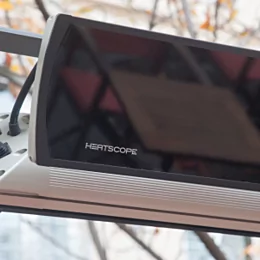
Radiant heaters deliver targeted warmth with even heat distribution, with no drafts and no cold spots, creating a quiet, allergy‑friendly ambience indoors and out. Engineered with infrared technology, HEATSCOPE® radiant heaters pair energy‑efficient performance with refined design, offering fast, comfortable heat and lower running costs for contemporary spaces.
Models
Showing 3 items of 3
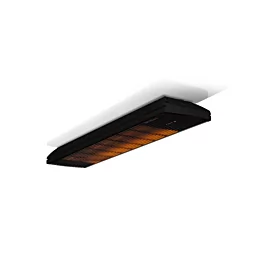
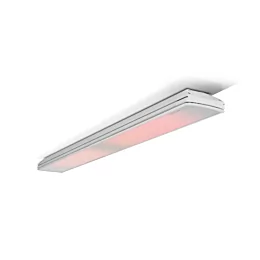
Spot 2800W Electric Radiant Heater · HEATSCOPE® Heaters
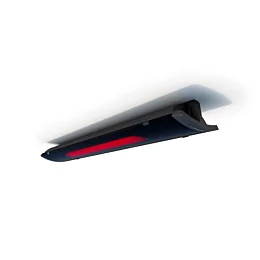
Vision 3200W Electric Radiant Heater · HEATSCOPE® Heaters
Pure+ 3000W Electric Radiant Heater · HEATSCOPE® Heaters

Loading image...


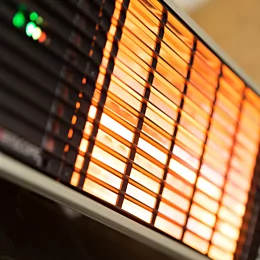
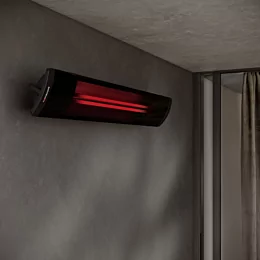
Carbon spiral heating technology
Dual carbon heating spirals power our radiant heaters with reduced visible light and a naturally cosy feel.
Loading image...


Energy‑efficient radiant heaters
HEATSCOPE radiant heaters convert 90–94% of energy into ambient warmth for low running costs and high comfort.
Loading image...


Rapid heat‑up times
Spot radiant heaters reach full output in about 15 seconds; Pure and Vision models ramp quickly owing to the glass‑ceramic front.
Two‑stage output control
Radiant heaters with 50% and 100% output modes via remote or hardwire for precise zone heating and energy optimisation.
Loading image...

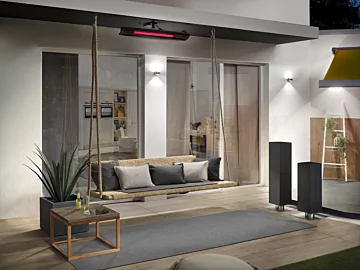
Outdoor‑ready IP protection
Pure radiant heaters are IP65 rated for exposed installs; Spot and Vision are IP24 for well‑covered areas.
Learn More
Radiant Heaters
Outdoor Radiant Heaters
FAQ's
Can outdoor radiant heaters be used in covered outdoor areas like pergolas?
Yes, weather-resistant outdoor radiant heaters are purpose-built for covered areas like pergolas, and a sheltered structure is the ideal setting for infrared heating. Because the heat travels in a direct beam to warm people and surfaces rather than the surrounding air, a pergola roof helps contain that warmth without the wind dispersion open patios experience.
Pergola installation comes down to clearances and mount choice. Heatscope models accept wall or ceiling mounting across the range, with a minimum 1,800 mm [70.9 in] clearance from the lower edge of the unit to the floor, and 200 mm [7.9 in] from any power source. When the pergola ceiling sits lower than standard, extension rods of 100, 300 or 500 mm drop the heater to the correct height. Timber pergolas are fine with Heatscope spacers, which maintain the recommended distance from combustible material. Installation must follow local electrical wiring standards and be carried out by a licensed electrician, connected through a residual current device (RCD).
How much does it cost to run a HEATSCOPE® outdoor heater per hour?
Running a weather-resistant HEATSCOPE outdoor radiant heater costs roughly the heater's wattage divided by 1,000, multiplied by your local electricity rate per kWh. A 3,000 W heater run for one hour uses 3 kWh, so at an illustrative rate of $0.20/kWh it costs about $0.60 per hour to run.
Per-hour figures across the range, at the same illustrative $0.20/kWh rate:
- 1,600 W compact heater: $0.32/hour at full output, $0.16/hour at 50%
- 2,800 W heater: $0.56/hour at full output, $0.28/hour at 50%
- 3,000 W heater: $0.60/hour at full output, $0.30/hour at 50%
- 3,200 W heater: $0.64/hour at full output, $0.32/hour at 50%
Actual cost depends on your local electricity rate, so replace the illustrative figure with your own tariff for an accurate calculation. A two-hour session at full output on a 3,000 W heater sits near $1.20 at that rate; running the same session at the 50% setting drops the cost to around $0.60.
Mid-wave infrared technology converts up to 94% of energy directly into directed warmth, with minimal energy lost to air or wind dispersion. That efficiency, combined with permanent outdoor installation and weather-resistant construction, is what keeps the cost per comfortable hour low across patios, terraces, and hospitality settings.
How quickly do HEATSCOPE® outdoor heaters warm up?
HEATSCOPE weather-resistant infrared heaters reach full output in under 15 seconds on most models; the glass-fronted range reaches comfortable warmth in under 60 seconds. You feel the warmth almost the moment the heater switches on, because infrared radiation travels through the air like sunlight and warms people and surfaces directly rather than heating the surrounding atmosphere.
That direct-to-body transfer is why outdoor patio heating with infrared behaves differently from a gas patio heater or a fan heater. There is no lag while the air temperature climbs, and almost no heat loss to wind or open sides of a pergola. Two practical benefits follow:
- Guests arriving to a cold terrace feel warmth within seconds of the heater being switched on, rather than waiting 20 to 30 minutes for air temperature to rise.
- Instant-on, instant-off operation means you only run the heater during occupied moments, keeping energy use close to actual occupancy time.
Carbon fibre elements are rated for at least 10,000 operating hours, and radiant efficiency across the range sits between 87 and 94 percent, so that fast warmth is delivered consistently across years of residential or commercial use.
How do HEATSCOPE® radiant heaters compare to other outdoor electric heaters?
HEATSCOPE® radiant heaters deliver direct heat transfer using mid-wave infrared technology that penetrates the first skin layers, creating genuine sun-like warmth rather than surface heating. Unlike many electric outdoor heaters that rely on short-wave infrared producing bright red glows and uncomfortable high-intensity heat, HEATSCOPE® heaters use colour-matched grill screens to reduce light output to just 30-40% of traditional radiant heaters. The Spot series produces approximately 600 lumens (per product specifications), whilst the Vision and Pure Plus ranges deliver less than 300 lumens, preserving outdoor ambience without harsh brightness.
The engineering differences extend to durability and materials. HEATSCOPE® heaters use carbon fibre heating elements and, in the Pure Plus range, SCHOTT NEXTREMA® premium convex glass, a material exclusivity among electric infrared heaters. The Pure model achieves IP65 weather resistance (dust and waterproof), exceeding the typical IPX5 rating of competitors, ensuring reliable outdoor performance across seasons.
For connected home environments, an optional ZigBee Bridge enables wireless control, motion sensors for automated triggering, and compatibility with Alexa and Google Assistant. An optional WiFi Smart Switch adds smartphone app control. Dual power levels at 50% and 100% output allow precise zone heating for energy efficiency without waste.
What is infrared radiant heating technology?
Infrared radiant heating technology uses direct heat transfer: electromagnetic waves deliver warmth from the heater to people and surfaces, bypassing the surrounding air entirely. HEATSCOPE radiant heaters emit mid-wave infrared radiation that is absorbed by solid objects (people, floors, surfaces) on contact. Because air is largely transparent to these wavelengths, warmth is not lost to wind, draughts, or dispersal in open spaces.
Mid-wave infrared is quickly absorbed by solid surfaces and skin, replicating the natural sensation of direct sunlight without heating the air around you. HEATSCOPE's dual carbon spiral heating elements emit this radiation through ceramic glass fronts with minimal visible light, delivering quiet, directed warmth. Designed to German engineering standards, this technology performs consistently indoors and in exposed outdoor environments.
Is radiant heating suitable for all room types?
Radiant heating is suitable for most room types, with a few environment-specific exceptions to guide installation decisions.
Heatscope radiant heaters work well in living areas, dining rooms, bedrooms, kitchens, bathrooms, hallways, and open-plan spaces. The infrared heat carries through air without relying on ventilation or air circulation, making it particularly effective in enclosed, draught-prone, or high-ceiling rooms where forced-air systems underperform. Heat reaches occupants directly rather than dissipating overhead.
Environments where standard installation is not appropriate:
German-engineered and Red Dot Design Award winning, Heatscope heaters are tested rigorously across climates. The technology's independence from ducting and gas lines lets it adapt to any room geometry without constraining architecture.
What types of outdoor radiant heaters are available?
Heatscope offers four ranges of weather-resistant electric infrared heaters, each engineered for different settings and design preferences. All use double carbon heating elements with two-stage output control and come in black or white with optional extension rods.
The Spot is the most compact, available in 1,600W or 2,800W, ideal for smaller spaces and directional warmth. Its ceramic glass front delivers radiant efficiency above 94%, with an IP24 rating suitable for covered outdoor areas.
The Pure Plus is the most weather-resistant in the range, rated IP65 for fully exposed outdoor installation. This 3,000W heater features a convex glass-ceramic front and won a Red Dot Design Award in 2018.
The Vision produces the highest output at 3,200W and runs the longest at 1,661 mm, creating ambient atmosphere alongside substantial warmth. Its minimal visible light (300 lm) suits settings where you want heat without visual prominence. It’s rated IP44.
The Next suits transitional spaces, including semi-enclosed terraces or indoor/outdoor transitions. Its 3,000W output and swivel-joint mount offer directional flexibility; its slim aluminium body fits tighter design schemes. It’s rated IP25.
All ranges include a 2-year warranty and optional ZigBee smart control.
What are the pros and cons of radiant heating?
Direct heat transfer is the fundamental advantage of radiant heating, which warms people and objects in its path rather than heating the surrounding air. This delivers several distinct benefits: energy conversion rates of 87–94%, near-instant warmth within 15–60 seconds depending on the model, and silent operation with no moving parts. Radiant heaters produce no emissions, odours, or ash, and require no gas lines, flue systems, or ventilation infrastructure, making them ideal for retrofit installations and spaces where traditional heating isn’t practical.
The trade-off is directional coverage. Radiant heaters warm only the areas within their line-of-sight. Someone standing outside the beam path receives minimal benefit. This also means they function as zone heaters rather than whole-room ambient heating, effective for creating comfort zones in outdoor entertaining areas or specific indoor spaces, but less efficient for warming every corner of large rooms simultaneously. Covering expansive areas requires multiple units, which carries a higher upfront cost than a single centrally-mounted system. Installation demands appropriate electrical infrastructure (220–240V, professional installation), and in cold climates, multiple heaters may be necessary to achieve ambient comfort comparable to forced-air or hydronic systems.
Rather than limitations, many customers view these characteristics as precision advantages: the ability to heat only occupied spaces, reduce energy consumption, and extend the usable season in outdoor areas without the capital expense of full-home heating infrastructure.
Are HEATSCOPE® outdoor heaters suitable for commercial hospitality use?
Yes, HEATSCOPE® weather-resistant infrared heaters are engineered for both residential and commercial applications, and are installed in restaurants, cafes, bars, and hospitality venues.
Commercial durability is built into the core components. Carbon fibre heating elements are rated for at least 10,000 hours of operation, and the aluminium chassis resists discolouration and tarnishing over years of continuous service. There are no ignition components, gas connections, valves, or hoses to maintain, reducing downtime and servicing complexity in high-use environments.
For multi-zone installations, a single remote pairs with multiple heaters, and ZigBee motion sensors automate zones to activate only when areas are occupied, helping manage energy use across large terrace or dining areas. All models accept wall and ceiling mounting, with extension rods in 100, 300, and 500 mm increments providing height flexibility across varying ceiling configurations such as marquees, pergolas, and outdoor dining pavilions.
For venue specification, HEATSCOPE®’s technical team provides schematic diagrams and tailored positioning guidance based on your space’s dimensions, wind exposure, and installation height. The general principle: more wind exposure and greater installation height call for higher-output models with stronger beam reach.
What is two-stage output control on HEATSCOPE® heaters?
Two-stage output control lets weather-resistant HEATSCOPE radiant heaters switch between 100% and 50% power, so you can match heat delivery to conditions without turning the heater off. On a mild evening, 50% output keeps a patio comfortable while roughly halving energy draw; on colder nights, full power delivers the direct infrared warmth the heaters are engineered for.
The two levels are switchable from a wall switch, an included or optional 2-step infrared remote, or, with a WiFi wall switch, a smartphone and voice assistants like Alexa and Google Assistant. One remote can pair with multiple heaters, which is useful across larger covered areas or split zones in a restaurant or bar setting where different sections need different heat levels at once. ZigBee accessories extend this further on select models for motion-triggered or scene-based control.
Because HEATSCOPE heaters draw significant power at full output, the levels are fixed at 50% and 100%; a standard dimmer is not compatible. That fixed step is deliberate. It protects the heating elements and keeps infrared output stable and efficient at both settings.